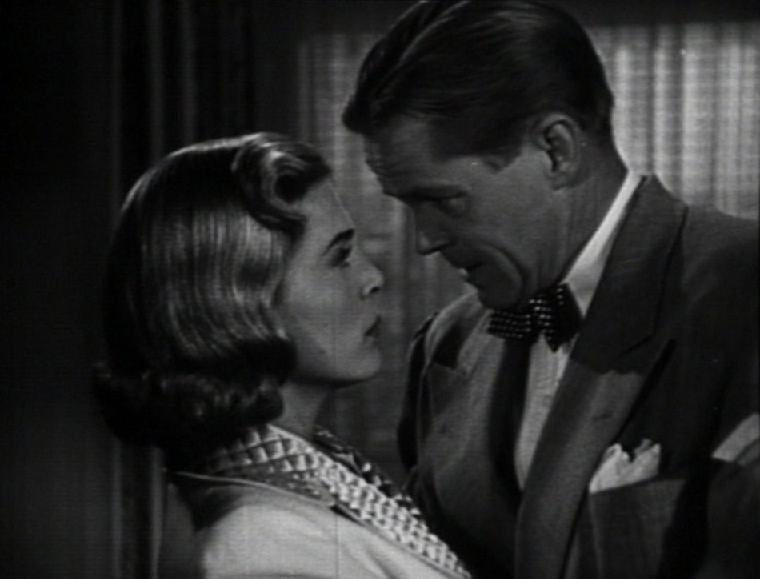
Showing posts with label Mark Stevens. Show all posts

Thursday, April 9, 2026

The Dark Corner (1946): The Eightieth Anniversary of the Film’s Premiere

Today is the eightieth anniversary of the premiere of The Dark Corner, and I’ll take all good reasons to see the film again. I wrote about The Dark Corner in September 2025 to celebrate the tenth anniversary of my blog. My very first blog article—in 2015—was about The Dark Corner. It’s a film I can see again and again and never tire of it.

The following list shows three blog articles that I have written about The Dark Corner. Click on each list item below to read more about the film:

◊ The Dark Corner (1946)

◊ Four Favorite Noirs: Born to Kill (1947), The Dark Corner (1946), Marlowe (1969), and Too Late for Tears (1949)

◊ Ten Years of Film Noir at Make Mine Film Noir, and It All Started in The Dark Corner (1946)

Kathleen Stuart (played by Lucille Ball) is a secretary working for Brad Galt (played by Mark Stevens). Galt is a San Francisco transplant hoping to start a new life working as a private investigator in New York City. He is haunted by his past. His former business partner in San Francisco framed him for an auto accident that wasn’t his fault. Now, in New York City, someone is using this information against him to commit murder and pin the crime on him. The story starts with a mysterious stranger following Kathleen and Brad on their first date. Kathleen is in love with her boss, and she is willing to help him clear his name.

The start of the baseball season in the United States is barely two weeks old, so I will say again that Kathleen Stuart uses a running baseball metaphor to describe the start of her courtship with Brad Galt. It’s a metaphor she brings up more than once. The on-screen chemistry works so well between Kathleen and Brad, and one of the reasons for that is because it’s not long into the story before Brad is embellishing the metaphor, too.

For example, after one of their first dates, Brad brings Kathleen to the front door of her apartment building and expresses disappointment when she makes it clear that she won’t be inviting him up. He insists that he is thirsty and in need of a glass of water, but Kathleen stands firm: “There you go again, pitching low and outside.” Brad reluctantly agrees to leave and goes back down the steps of the front stoop. On the sidewalk at the bottom of the stairs, he gives the “safe” sign. (It’s hard to see in the photo below, but that is Brad giving the “safe” sign in front of Kathleen’s apartment building.)

The “safe” sign wasn’t obvious to everyone apparently. I bring up this particular example because it wasn’t obvious to James Ursini. In the DVD commentary for The Dark Corner provided by Alain Silver and James Ursini, Ursini admits that he didn’t know what Brad was doing when he saw the film for the first time. He says something along the lines of “Here we have the double entendre stuff, with baseball and umps, when he [Brad] does his little routine being safe. [pause] Or does that mean ‘out’?” Silver tells him that Ursini was right the first time.

I was surprised by this because I thought everyone knew the sign for “safe” in baseball. It’s my favorite sport, but I am not the most dedicated fan and follow it intermittently, and even I knew what Brad was trying to do. But the truth is that you don’t need to know anything about baseball to enjoy The Dark Corner.

If you haven’t seen the film yet, you have something to look forward to—whether or not you know anything at all about baseball. I remember how much I enjoyed The Dark Corner the first time I saw it (really every time I see it). I cannot recommend it enough.

Have I seen the film eighty times? No, not even close. But I am working on it!

April 9, 1946, release date  •  Directed by Henry Hathaway  •  Screenplay by Bernard C. Schoenfeld and Jay Dratler •  Based on a story by Leo Rosten  •  Music by Cyril J. Mockridge  •  Edited by J. Watson Webb, Jr.  •  Cinematography by Joseph MacDonald

Lucile Ball as Kathleen Stuart  •  Mark Stevens as Bradford Galt  •  Clifton Webb as Hardy Cathcart  •  William Bendix as Stauffer, alias Fred Foss, White Suit  •  Kurt Kreuger as Anthony Jardine  •  Cathy Downs as Mari Cathcart  •  Reed Hadley as Lieutenant Frank Reeves  •  Constance Collier as Mrs. Kingsley  •  Eddie Heywood as himself, playing with his orchestra  •  Molly Lamont as Lucy Wilding  •  Ellen Corby as the maid

Distributed by Twentieth Century Fox  •  Produced by Twentieth Century Fox

Sunday, September 7, 2025

Ten Years of Film Noir at Make Mine Film Noir, and It All Started in The Dark Corner (1946)

Make Mine Film Noir celebrates its tenth anniversary!

Ten years ago today, I launched Make Mine Film Noir with an article about The Dark Corner (1946). The film is one of my all-time favorites, and to celebrate, I saw it again. (Okay. I admit it: I have seen the film several times in-between.)

I am happy to report that Brad Galt and Kathleen Stuart, the two main characters, are just as entertaining and engaging as ever. In spite of reports that Lucille Ball hated the film and hated working on it, the chemistry between her character and Stevens’s is still there on-screen. Their repartee certainly helps: It looks like both actors are having fun delivering their lines. And they aren’t the only ones. Almost all the characters have a chance to shine with puns and comedic lines, especially Hardy Cathcart, played by Clifton Webb.

The snappy dialogue isn’t the only clever use of language. I think other writers would also appreciate Brad Galt’s line to Lieutenant Frank Reeves when the latter comes calling to check on Galt at his new office: “I’m playing this [his private investigation firm] by the book, and I won’ even trip over a comma.”

And then there is the running baseball metaphor that Kathleen Stuart uses at the start of her courtship with Brad, something she brings up more than once. And because the on-screen chemistry is working, it’s not long before Brad is embellishing the metaphor. How can Kathleen—and viewers, too—not be charmed by this handsome private investigator? And all because her father was a major league umpire!

The film also uses slang terms that are unusual even for film noir. Film noir uses a lot of slang from the 1940s and 1950s, and I almost always use captioning to figure out what the characters are saying. I often have to consult online dictionaries to learn the meanings of words that are unfamiliar to me, to probably all film viewers today. Here are just two examples from The Dark Corner:

◊ pepper pot = handgun

◊ shagging = following someone, tailing a suspect (not the meaning of the term in British English)

Both are obvious from the context in the film, which is a lucky break because I tried to find them online and couldn’t.

This description might make people think that The Dark Corner is not a film noir at all, but that couldn’t be further from the truth. Be warned: There is plenty of violence and betrayal to go around.

I have written about The Dark Corner twice before on this blog. Click on each list item below to read more about the film:

◊ The Dark Corner (1946)

◊ Four Favorite Noirs: Born to Kill (1947), The Dark Corner (1946), Marlowe (1969), and Too Late for Tears (1949)

Next year, on April 9, 2026, The Dark Corner celebrates its eightieth anniversary. I’ll be seeing it again, I’m sure.

What amazes me after ten years is that I have just scratched the surface, that I have more noir to see, enjoy, and write about. I hope to keep writing for another ten years.

April 9, 1946, release date  •  Directed by Henry Hathaway  •  Screenplay by Bernard C. Schoenfeld and Jay Dratler •  Based on a story by Leo Rosten  •  Music by Cyril J. Mockridge  •  Edited by J. Watson Webb, Jr.  •  Cinematography by Joseph MacDonald

Lucile Ball as Kathleen Stuart  •  Mark Stevens as Bradford Galt  •  Clifton Webb as Hardy Cathcart  •  William Bendix as Stauffer, alias Fred Foss, White Suit  •  Kurt Kreuger as Anthony Jardine  •  Cathy Downs as Mari Cathcart  •  Reed Hadley as Lieutenant Frank Reeves  •  Constance Collier as Mrs. Kingsley  •  Eddie Heywood as himself, playing with his orchestra  •  Molly Lamont as Lucy Wilding  •  Ellen Corby as the maid

Distributed by Twentieth Century Fox  •  Produced by Twentieth Century Fox

Thursday, February 23, 2023

The Snake Pit (1948)

I’ve never heard The Snake Pit described as a film noir, but I’m going to call it noir anyway. Many films noir address social justice issues, and on that basis alone, The Snake Pit qualifies. And if one agrees that most films noir address existential issues of angst and loneliness, The Snake Pit qualifies on that point, too. I’ve never been a huge fan of categories, and this is another chance to break the not-so-hard-and-fast rules.

The film is based on a novel by Mary Jane Ward, who in turn based it on her own experiences in a state mental health hospital. The field of mental health was dismal, to put it mildly, in the 1940s, when The Snake Pit was released. From the film’s depiction alone, it’s a wonder that Ward survived her mental health issues and her stay in the hospital. I haven’t read the novel, but the DVD commentary by film historian Aubrey Solomon describes it as more detailed, more intense, and more discouraging than the film, and I found the film to be tough to watch.

In the spring of 2021, Library of America reissued Mary Jane Ward’s novel for the seventy-fifth anniversary of its original release. Click here to see an article and interview with Larry Lockridge, a relative of Ward’s, who wrote the afterword for the new edition. In the interview, he discusses the novel and the film, among other topics.

The film starts with a shot of birds chirping in a tree, and the camera pans down to a woman, Virginia, sitting on a park bench. She talks in turn to two men, who are revealed to be imaginary, and to another woman, Grace, who is sitting on the bench not far from her. Virginia doesn’t know where she is and believes everyone around her are strangers. Someone calls out and asks everyone to line up, and Grace takes Virginia by the hand and pulls her into line with several other women. Virginia thinks that they are visiting a zoo when she sees some women behind what look like prison bars. Then she is afraid that they are trapped in a prison. She isn’t sure if she is married, and she doesn’t recognize her husband, Robert, when he comes to visit.

(This article about The Snake Pit contains some spoilers.)

The opening of the film apparently shows Virginia as a recent arrival to the mental health hospital. Her husband Robert is there on this same day, and he is dismayed when Virginia doesn’t recognize him. Robert is at the hospital to discuss Virginia’s case history with one of her doctors, Dr. Kik (no one can pronounce Dr. Kensdelaerik’s last name, so everyone calls him Dr. Kik). The doctor pulls out a file with Juniper Hill State Hospital on it, and this is the point when viewers are finally sure of the setting. Until this point, viewers were seeing events more or less from Virginia’s perspective. Dr. Kik wants to go over Virginia’s case history with her husband because there’s so little in it. But her husband doesn’t know a lot about his wife’s personal history. He says that she never talked much about her family when he first met her and still doesn’t. Robert tells Dr. Kik about what he does know, and he starts with meeting Virginia at one of his first jobs after being discharged from the service in World War II, which is told in flashback.
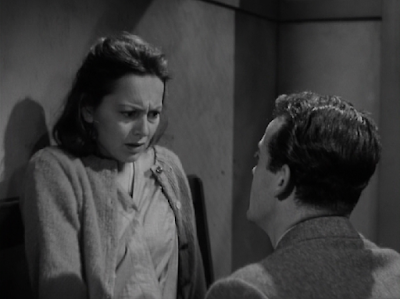
On a subsequent visit to the hospital, Robert signs the consent forms for electroshock treatment. Virginia eventually has four of them. She also undergoes narcosynthesis treatment, during which she reveals more about her past and her fears to Dr. Kik. She had a boyfriend named Gordon who died in a car accident; Virginia survived the accident, and she blames herself for Gordon’s death. She also blames herself for her father’s death during her early childhood on May 12, and her mental health deteriorates badly on and around that date every year since.

Some of the treatment methods depicted in the film are disturbing to watch, so much so that I’m not sure I want to read the novel. The electroshock treatments were particularly difficult, but I also found the cold-water bath treatments odd and punitive: Patients are buttoned and restrained in the bath from the neck down, whether they like cold water or not. There is also a period when Virginia is straitjacketed, another restraint method that seems punitive, arbitrary, and even dangerous. The patients have little privacy and wander about at the mercy of the other patients and even the nurses and other staff members. In fact, the nurses treat the patients terribly. One nurse, for example, wouldn’t allow the female patients to walk on a large area rug in their ward simply because it was new.

The male doctors are portrayed as paternalistic. Most of them feel that they know what is best in all circumstances and don’t give much credence to patients’ feelings. Dr. Kik is an exception because he seems to care about Virginia’s welfare and treats her kindly. He consults with Virginia’s husband Robert, but Robert never enters the wards where the patients are housed. He doesn’t really know anything except what he can glean from seeing Virginia in communal visiting spaces and during doctor consultations. It’s not stated directly in the film, but I got the impression that once Robert brought Virginia to the hospital and signed any consent forms, he had little say in what happened to his wife. And any time Virginia spoke up, she was considered an unreliable source because of her mental health.

The DVD commentary by film historian Aubrey Solomon gives a lot of details about the making of the film and about the background of the original novel and its author. Here’s a list, which is extensive but certainly not exhaustive! The DVD commentary is well worth a listen.

◊ The opening scene with Virginia and Grace shows that this was not a typical Olivia de Havilland film. Olivia Haviland, in the role of Virginia, is shown with torn stockings and a hole in her sweater, and she is disheveled and not wearing any makeup.

◊ Olivia de Havilland did a lot of research for her role. She visited state hospitals and talked to doctors and patients.

◊ Reviews at the time were glowing. The film handled a serious subject well as entertainment that worked.

◊ The calendar syndrome applies to Virginia, whose symptoms get worse on May 12 each year. The calendar syndrome describes the effects of a traumatic event that recur on the same date each year.

◊ The novel was like a diary, with descriptions of daily life from the point of view of one character. To make a screenplay for a film, characters had to be fleshed out and scenes added to make a story. Studio head Darryl Zanuck was good at this, both in writing and in film editing.

◊ Twenty-six states changed their laws concerning the treatment of the mentally ill as a result of the treatment depicted in The Snake Pit. (Wikipedia also has some information about the impact that The Snake Pit had on legislation and social policy. Click here for more information.)

◊ At one point in the film, Virginia locks herself in a bathroom to hide from the head nurse, Nurse Davis. The bathroom is clean, but that wasn’t the case in the novel. The bathrooms were dirty, there was no privacy, and the patients showered only twice a week. This information was part of the case against state institutions.

◊ Until The Snake Pit came out, the public didn’t know what went on at state mental health institutions because they were off limits to visitors. Family members and relatives who came to visit were only allowed in certain spaces that were kept clean and well maintained.

◊ Dr. Kik’s explanation of how Virginia got sick, starting probably in babyhood, is Freudian. (Freud and psychotherapy were popular themes in film noir.)

Solomon doesn’t call The Snake Pit a film noir, but I still do. It’s a great film, whatever you choose to call it, but it’s not a film that one recommends without some caveats. It is disturbing, even for a 1948 release, even in black and white.

November 13, 1948, release date  •  Directed by Anatole Litvak  •  Screenplay by Frank Partos, Millen Brand, Arthur Laurents  •  Based on the novel The Snake Pit by Mary Jane Ward  •  Music by Alfred Newman  •  Edited by Dorothy Spencer  •  Cinematography by Leo Tover

Olivia de Havilland as Virginia Stuart Cunningham  •  Mark Stevens as Robert Cunningham  •  Leo Genn as Dr. Mark H. Van Kensdelaerik (aka Dr. Kik)  •  Celeste Holm as Grace  •  Glenn Langan as Dr. Terry  •  Helen Craig as Nurse Davis  •  Leif Erickson as Gordon  •  Beula Bondi as Mrs. Greer  •  Lee Patrick as an asylum inmate  •  Howard Freeman as Dr. Curtis  •  Natalie Schafer as Mrs. Stuart  •  Damian O’Flynn as Mr. Stuart  •  Ruth Donnelly as Ruth  •  Katherine Locke as Margaret  •  Celia Lovsky as Gertrude  •  Frank Conroy as Dr. Jonathan Gifford  •  Minna Gombell as Ms. Hart  •  Betsy Blair as Hester  •  Jacqueline deWit as Celia Sommerville  •  Lora Lee Michel as Virginia at age six  •  Jan Clayton as the inmate singing at the dance

Distributed by Twentieth Century Fox  •  Produced by Twentieth Century Fox

Sunday, May 15, 2022

Four Favorite Noirs: Born to Kill (1947), The Dark Corner (1946), Marlowe (1969), and Too Late for Tears (1949)

To celebrate National Classic Movie Day on May 16, Rick at Classic Film & TV Café is hosting the Four Favorite Noirs Blogathon. What a great idea! My only qualm: How am I going to pick only four!

I managed to whittle my list down, as requested, but it was tough. And I cheated a little by including a neo-noir. I decided to write about four little-known noirs because I think they deserve to be seen at least once. If you want to see them again and again, like I do, so much the better!

◊ Born to Kill (1947), starring Claire Trevor and Lawrence Tierney

Born to Kill is a gritty look at two people who are a match made in hell. Sam Wild (Lawrence Tierney) and Helen Brent (Claire Trevor) are attracted to one another for all the wrong reasons. Both of them are turned on by violence and death, and their story doesn’t end well for either one of them (but you already know that because this is film noir). Born to Kill is a perfect example of a noir that shows you what you shouldn’t be doing if you want to avoid the dreadful consequences of a life of crime—that is, in case you are toying with the idea of a life of crime! Tierney and Trevor are fantastic in their lead roles. And many of the supporting actors, some of the great character actors of film noir—Walter Slezak, Elisha Cook Jr., Esther Howard—are, too.

I watched Born to Kill on DVD, with commentary by noir expert Eddie Muller. Muller’s commentary is packed with information about the film, the director, and the actors. In fact, the commentary includes some recorded material from director Robert Wise, and Muller recounts some of his personal experiences meeting Lawrence Tierney, which adds to the fun. RKO produced Born to Kill as an A picture, a vehicle to make Tierney a leading man and star. But Tierney’s own proclivities toward violence off-screen helped sabotage that plan. If you watch Born to Kill on DVD, I highly recommend Muller’s commentary, too.

◊ The Dark Corner (1946), starring Mark Stevens and Lucille Ball

• Brad Galt: “There goes my last lead. I feel all dead inside. I’m backed up in a dark corner, and I don’t know who’s hitting me.”

The Dark Corner is one of those films I can watch again and again and never tire of it. The witty dialogue is one of the things I like best about the film. The repartee between Kathleen Stuart (Lucille Ball) and Brad Galt (Mark Stevens) is so much fun. And their on-screen chemistry works, too, which is amazing when you consider that Lucille Ball was going through a rough patch in her marriage to Desi Arnaz and that she hated working on this film. Somehow Lucille Ball and her costars make it work, and I found myself rooting for Kathleen and Brad to succeed every step of the way.

Lucille Ball is given top billing, but her costar, Mark Stevens is fourth in the list. Two great noir actors come second and third: Clifton Webb (who plays Hardy Cathcart) and William Bendix (who plays White Suit). Their performances add so much to a great film. Clifton Webb has some dry lines and observations that add an appropriately cynical touch, and he can exude menace when he needs to. William Bendix is the hired thug who knows what he’s doing—until he is outwitted, that is, by . . . well, no spoilers this time because this is a good one.

◊ Marlowe (1969), starring James Garner and Rita Moreno

Forget about Humphrey Bogart! Forget about Dick Powell! Don’t get me wrong: I happen to like both of them as Philip Marlowe, but Marlowe has James Garner. And he gives one of the best portrayals of Philip Marlowe. Yes, he is that Philip Marlowe, Raymond Chandler’s famous detective. Another huge plus is Rita Moreno, who costars as Dolores Gonzáles. Moreno, in addition to having a well-deserved “moment” in 2022, is fantastic in Marlowe. Is Gonzáles really a good friend to Mavis Wald, or is she the femme fatale in this story? She keeps everyone, including Marlowe, guessing.

The film is adapted by Stirling Sillphant from Chandler’s novel The Little Sister. The film takes place in 1969, but the story is updated to fit the times while managing to stay true to the novel. For instance, the film opens with Marlowe driving up to a ramshackle beach hotel called The Infinite Pad. People in hippie-style clothing lounge about on the front stairs and porch. And Marlowe shows up in his suit jacket and tie, trying to find the lost brother of his client, one Orfamay Quest. Philip Marlowe is a throwback to the past, a relic of pulp novels from the 1930s and 1940s, but Silliphant’s screenplay and James Garner’s portrayal make Philip Marlowe relevant still in 1969 and so much fun to watch in 2022.

◊ Too Late for Tears (1949), starring Lizabeth Scott and Dan Duryea

In France, Too Late for Tears is called La tigresse, the perfect name for Lizabeth Scott’s character Jane Palmer. It’s the French translation of Danny Fuller’s (Dan Duryea) nickname for Jane. The minute Jane gets behind the wheel of the car at the start of the film, orders her husband Alan to get in, and drives off with a bag of stolen money thrown into their backseat, you know you are in the noir universe. Jane wants her slice of the American dream, and she doesn’t care who she has to cut out of the picture to get it. Only one man can match her scheme for scheme.

Too Late for Tears holds a special place in my heart because I could swear that I saw it as a child on television. It was Don DeFore who made me wonder. If you are used to seeing him in the television sitcom Hazel or other film comedies, you’re in for a real treat. His performance as Don Blake is certainly memorable. And that’s quite an achievement in a film with two noir greats in Lizabeth Scott and Dan Duryea.

This article about Born to Kill, The Dark Corner, Marlowe, and Too Late for Tears is my entry for the Four Favorite Noirs Blogathon, which is presented by Rick at Classic Film & TV Café to celebrate National Classic Movie Day on May 16. Click here for the complete list of blogathon participants and links to their blogs. The list will be updated throughout the day.