Showing posts with label Lucille Ball. Show all posts

Thursday, April 9, 2026

The Dark Corner (1946): The Eightieth Anniversary of the Film’s Premiere

Today is the eightieth anniversary of the premiere of The Dark Corner, and I’ll take all good reasons to see the film again. I wrote about The Dark Corner in September 2025 to celebrate the tenth anniversary of my blog. My very first blog article—in 2015—was about The Dark Corner. It’s a film I can see again and again and never tire of it.

The following list shows three blog articles that I have written about The Dark Corner. Click on each list item below to read more about the film:

◊ The Dark Corner (1946)

◊ Four Favorite Noirs: Born to Kill (1947), The Dark Corner (1946), Marlowe (1969), and Too Late for Tears (1949)

◊ Ten Years of Film Noir at Make Mine Film Noir, and It All Started in The Dark Corner (1946)

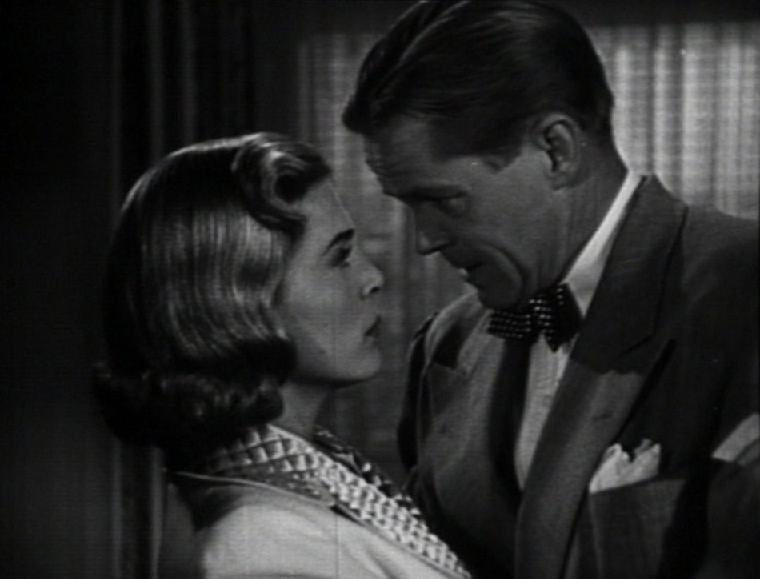
Kathleen Stuart (played by Lucille Ball) is a secretary working for Brad Galt (played by Mark Stevens). Galt is a San Francisco transplant hoping to start a new life working as a private investigator in New York City. He is haunted by his past. His former business partner in San Francisco framed him for an auto accident that wasn’t his fault. Now, in New York City, someone is using this information against him to commit murder and pin the crime on him. The story starts with a mysterious stranger following Kathleen and Brad on their first date. Kathleen is in love with her boss, and she is willing to help him clear his name.

The start of the baseball season in the United States is barely two weeks old, so I will say again that Kathleen Stuart uses a running baseball metaphor to describe the start of her courtship with Brad Galt. It’s a metaphor she brings up more than once. The on-screen chemistry works so well between Kathleen and Brad, and one of the reasons for that is because it’s not long into the story before Brad is embellishing the metaphor, too.

For example, after one of their first dates, Brad brings Kathleen to the front door of her apartment building and expresses disappointment when she makes it clear that she won’t be inviting him up. He insists that he is thirsty and in need of a glass of water, but Kathleen stands firm: “There you go again, pitching low and outside.” Brad reluctantly agrees to leave and goes back down the steps of the front stoop. On the sidewalk at the bottom of the stairs, he gives the “safe” sign. (It’s hard to see in the photo below, but that is Brad giving the “safe” sign in front of Kathleen’s apartment building.)

The “safe” sign wasn’t obvious to everyone apparently. I bring up this particular example because it wasn’t obvious to James Ursini. In the DVD commentary for The Dark Corner provided by Alain Silver and James Ursini, Ursini admits that he didn’t know what Brad was doing when he saw the film for the first time. He says something along the lines of “Here we have the double entendre stuff, with baseball and umps, when he [Brad] does his little routine being safe. [pause] Or does that mean ‘out’?” Silver tells him that Ursini was right the first time.

I was surprised by this because I thought everyone knew the sign for “safe” in baseball. It’s my favorite sport, but I am not the most dedicated fan and follow it intermittently, and even I knew what Brad was trying to do. But the truth is that you don’t need to know anything about baseball to enjoy The Dark Corner.

If you haven’t seen the film yet, you have something to look forward to—whether or not you know anything at all about baseball. I remember how much I enjoyed The Dark Corner the first time I saw it (really every time I see it). I cannot recommend it enough.

Have I seen the film eighty times? No, not even close. But I am working on it!

April 9, 1946, release date  •  Directed by Henry Hathaway  •  Screenplay by Bernard C. Schoenfeld and Jay Dratler •  Based on a story by Leo Rosten  •  Music by Cyril J. Mockridge  •  Edited by J. Watson Webb, Jr.  •  Cinematography by Joseph MacDonald

Lucile Ball as Kathleen Stuart  •  Mark Stevens as Bradford Galt  •  Clifton Webb as Hardy Cathcart  •  William Bendix as Stauffer, alias Fred Foss, White Suit  •  Kurt Kreuger as Anthony Jardine  •  Cathy Downs as Mari Cathcart  •  Reed Hadley as Lieutenant Frank Reeves  •  Constance Collier as Mrs. Kingsley  •  Eddie Heywood as himself, playing with his orchestra  •  Molly Lamont as Lucy Wilding  •  Ellen Corby as the maid

Distributed by Twentieth Century Fox  •  Produced by Twentieth Century Fox

Sunday, September 7, 2025

Ten Years of Film Noir at Make Mine Film Noir, and It All Started in The Dark Corner (1946)

Make Mine Film Noir celebrates its tenth anniversary!

Ten years ago today, I launched Make Mine Film Noir with an article about The Dark Corner (1946). The film is one of my all-time favorites, and to celebrate, I saw it again. (Okay. I admit it: I have seen the film several times in-between.)

I am happy to report that Brad Galt and Kathleen Stuart, the two main characters, are just as entertaining and engaging as ever. In spite of reports that Lucille Ball hated the film and hated working on it, the chemistry between her character and Stevens’s is still there on-screen. Their repartee certainly helps: It looks like both actors are having fun delivering their lines. And they aren’t the only ones. Almost all the characters have a chance to shine with puns and comedic lines, especially Hardy Cathcart, played by Clifton Webb.

The snappy dialogue isn’t the only clever use of language. I think other writers would also appreciate Brad Galt’s line to Lieutenant Frank Reeves when the latter comes calling to check on Galt at his new office: “I’m playing this [his private investigation firm] by the book, and I won’ even trip over a comma.”

And then there is the running baseball metaphor that Kathleen Stuart uses at the start of her courtship with Brad, something she brings up more than once. And because the on-screen chemistry is working, it’s not long before Brad is embellishing the metaphor. How can Kathleen—and viewers, too—not be charmed by this handsome private investigator? And all because her father was a major league umpire!

The film also uses slang terms that are unusual even for film noir. Film noir uses a lot of slang from the 1940s and 1950s, and I almost always use captioning to figure out what the characters are saying. I often have to consult online dictionaries to learn the meanings of words that are unfamiliar to me, to probably all film viewers today. Here are just two examples from The Dark Corner:

◊ pepper pot = handgun

◊ shagging = following someone, tailing a suspect (not the meaning of the term in British English)

Both are obvious from the context in the film, which is a lucky break because I tried to find them online and couldn’t.

This description might make people think that The Dark Corner is not a film noir at all, but that couldn’t be further from the truth. Be warned: There is plenty of violence and betrayal to go around.

I have written about The Dark Corner twice before on this blog. Click on each list item below to read more about the film:

◊ The Dark Corner (1946)

◊ Four Favorite Noirs: Born to Kill (1947), The Dark Corner (1946), Marlowe (1969), and Too Late for Tears (1949)

Next year, on April 9, 2026, The Dark Corner celebrates its eightieth anniversary. I’ll be seeing it again, I’m sure.

What amazes me after ten years is that I have just scratched the surface, that I have more noir to see, enjoy, and write about. I hope to keep writing for another ten years.

April 9, 1946, release date  •  Directed by Henry Hathaway  •  Screenplay by Bernard C. Schoenfeld and Jay Dratler •  Based on a story by Leo Rosten  •  Music by Cyril J. Mockridge  •  Edited by J. Watson Webb, Jr.  •  Cinematography by Joseph MacDonald

Lucile Ball as Kathleen Stuart  •  Mark Stevens as Bradford Galt  •  Clifton Webb as Hardy Cathcart  •  William Bendix as Stauffer, alias Fred Foss, White Suit  •  Kurt Kreuger as Anthony Jardine  •  Cathy Downs as Mari Cathcart  •  Reed Hadley as Lieutenant Frank Reeves  •  Constance Collier as Mrs. Kingsley  •  Eddie Heywood as himself, playing with his orchestra  •  Molly Lamont as Lucy Wilding  •  Ellen Corby as the maid

Distributed by Twentieth Century Fox  •  Produced by Twentieth Century Fox

Sunday, May 15, 2022

Four Favorite Noirs: Born to Kill (1947), The Dark Corner (1946), Marlowe (1969), and Too Late for Tears (1949)

To celebrate National Classic Movie Day on May 16, Rick at Classic Film & TV Café is hosting the Four Favorite Noirs Blogathon. What a great idea! My only qualm: How am I going to pick only four!

I managed to whittle my list down, as requested, but it was tough. And I cheated a little by including a neo-noir. I decided to write about four little-known noirs because I think they deserve to be seen at least once. If you want to see them again and again, like I do, so much the better!

◊ Born to Kill (1947), starring Claire Trevor and Lawrence Tierney

Born to Kill is a gritty look at two people who are a match made in hell. Sam Wild (Lawrence Tierney) and Helen Brent (Claire Trevor) are attracted to one another for all the wrong reasons. Both of them are turned on by violence and death, and their story doesn’t end well for either one of them (but you already know that because this is film noir). Born to Kill is a perfect example of a noir that shows you what you shouldn’t be doing if you want to avoid the dreadful consequences of a life of crime—that is, in case you are toying with the idea of a life of crime! Tierney and Trevor are fantastic in their lead roles. And many of the supporting actors, some of the great character actors of film noir—Walter Slezak, Elisha Cook Jr., Esther Howard—are, too.

I watched Born to Kill on DVD, with commentary by noir expert Eddie Muller. Muller’s commentary is packed with information about the film, the director, and the actors. In fact, the commentary includes some recorded material from director Robert Wise, and Muller recounts some of his personal experiences meeting Lawrence Tierney, which adds to the fun. RKO produced Born to Kill as an A picture, a vehicle to make Tierney a leading man and star. But Tierney’s own proclivities toward violence off-screen helped sabotage that plan. If you watch Born to Kill on DVD, I highly recommend Muller’s commentary, too.

◊ The Dark Corner (1946), starring Mark Stevens and Lucille Ball

• Brad Galt: “There goes my last lead. I feel all dead inside. I’m backed up in a dark corner, and I don’t know who’s hitting me.”

The Dark Corner is one of those films I can watch again and again and never tire of it. The witty dialogue is one of the things I like best about the film. The repartee between Kathleen Stuart (Lucille Ball) and Brad Galt (Mark Stevens) is so much fun. And their on-screen chemistry works, too, which is amazing when you consider that Lucille Ball was going through a rough patch in her marriage to Desi Arnaz and that she hated working on this film. Somehow Lucille Ball and her costars make it work, and I found myself rooting for Kathleen and Brad to succeed every step of the way.

Lucille Ball is given top billing, but her costar, Mark Stevens is fourth in the list. Two great noir actors come second and third: Clifton Webb (who plays Hardy Cathcart) and William Bendix (who plays White Suit). Their performances add so much to a great film. Clifton Webb has some dry lines and observations that add an appropriately cynical touch, and he can exude menace when he needs to. William Bendix is the hired thug who knows what he’s doing—until he is outwitted, that is, by . . . well, no spoilers this time because this is a good one.

◊ Marlowe (1969), starring James Garner and Rita Moreno

Forget about Humphrey Bogart! Forget about Dick Powell! Don’t get me wrong: I happen to like both of them as Philip Marlowe, but Marlowe has James Garner. And he gives one of the best portrayals of Philip Marlowe. Yes, he is that Philip Marlowe, Raymond Chandler’s famous detective. Another huge plus is Rita Moreno, who costars as Dolores Gonzáles. Moreno, in addition to having a well-deserved “moment” in 2022, is fantastic in Marlowe. Is Gonzáles really a good friend to Mavis Wald, or is she the femme fatale in this story? She keeps everyone, including Marlowe, guessing.

The film is adapted by Stirling Sillphant from Chandler’s novel The Little Sister. The film takes place in 1969, but the story is updated to fit the times while managing to stay true to the novel. For instance, the film opens with Marlowe driving up to a ramshackle beach hotel called The Infinite Pad. People in hippie-style clothing lounge about on the front stairs and porch. And Marlowe shows up in his suit jacket and tie, trying to find the lost brother of his client, one Orfamay Quest. Philip Marlowe is a throwback to the past, a relic of pulp novels from the 1930s and 1940s, but Silliphant’s screenplay and James Garner’s portrayal make Philip Marlowe relevant still in 1969 and so much fun to watch in 2022.

◊ Too Late for Tears (1949), starring Lizabeth Scott and Dan Duryea

In France, Too Late for Tears is called La tigresse, the perfect name for Lizabeth Scott’s character Jane Palmer. It’s the French translation of Danny Fuller’s (Dan Duryea) nickname for Jane. The minute Jane gets behind the wheel of the car at the start of the film, orders her husband Alan to get in, and drives off with a bag of stolen money thrown into their backseat, you know you are in the noir universe. Jane wants her slice of the American dream, and she doesn’t care who she has to cut out of the picture to get it. Only one man can match her scheme for scheme.

Too Late for Tears holds a special place in my heart because I could swear that I saw it as a child on television. It was Don DeFore who made me wonder. If you are used to seeing him in the television sitcom Hazel or other film comedies, you’re in for a real treat. His performance as Don Blake is certainly memorable. And that’s quite an achievement in a film with two noir greats in Lizabeth Scott and Dan Duryea.

This article about Born to Kill, The Dark Corner, Marlowe, and Too Late for Tears is my entry for the Four Favorite Noirs Blogathon, which is presented by Rick at Classic Film & TV Café to celebrate National Classic Movie Day on May 16. Click here for the complete list of blogathon participants and links to their blogs. The list will be updated throughout the day.

Saturday, March 9, 2019

Lured (1947)

September 5, 1947, release date
Directed by Douglas Sirk
Screenplay by Leo Rosten
Based on a story by Jacques Companéez, Simon Gantillon, Ernest Neuville
Music by Michel Michelet
Edited by John M. Foley, James E. Newcom
Cinematography by William H. Daniels

George Sanders as Robert Fleming
Lucille Ball as Sandra Carpenter
Charles Coburn as Chief Inspector Harley Temple
Boris Karloff as Charles van Druten
Ann Codee as Matilda, van Druten’s assistant
Sir Cedric Hardwicke as Julian Wilde
Joseph Calleia as Dr. Nicholas Moryani
Alan Mowbray as Lyle Maxwell alias Maxim Duval, Moryani’s accomplice
George Zucco as Officer H. R. Barrett
Robert Coote as the detective
Alan Napier as Inspector Gordon
Tanis Chandler as Lucy Barnard
Ethelreda Leopold as the nightclub singer (voice dubbed by Annette Warren)
Gerald Hamer as Harry Milton
Lynne Baggett as Fleming’s girlfriend

Distributed by United Artists
Produced by Hunt Stromberg Productions

A serial killer is terrorizing London (not the small unnamed seaside community in Beast, the subject of one of my February blog posts). Lured has some of the same dark themes that Beast has, but a bit of humor lightens the story from time to time, mostly because of the character of Sandra Carpenter, played by Lucille Ball. Lured gives her a chance to show her serious dramatic abilities, too.

Lucille Ball is also great in The Dark Corner, one of my film noir favorites and my first post in this blog. Click here to see my blog post about The Dark Corner.

The opening credits are handled creatively, in a style fitting a story about a hunt for a serial killer. The film starts with a circle of light on pavement from a flashlight that is held by a man (viewers know that it is a man from the shot of his shoes). The camera focuses on the man’s shoes as he walks to a street curb, where he shines the circle of light on a crumpled newspaper from the London Enquirer lying in the gutter. Then he moves the flashlight, the circle of light, to and then up a short flight of steps, across a front door, and to a “nameplate” announcing “Hunt Stromberg presents.” The circle of light is used to reveal all the subsequent credits before the narrative begins.

Sandra Carpenter works as a taxi dancer in a London nightclub called the Palladium. The scenes in the nightclub give Lucille Ball the best opportunities to show off her comedic skills. Her dialogue includes many one-liners and some dry observations of her own occupation. One of Carpenter’s coworkers, Lucy Barnard, answers a personal ad and tells Sandra all about her upcoming meeting with someone named John. Instead of finding romance, however, Lucy becomes the serial killer’s eighth victim. Advertising in the personal ads, it seems, is the killer’s way of luring his victims. He also taunts the police by sending them poems written in the style of Baudelaire, specifically Baudelaire’s poems from The Flowers of Evil.

◊ Wikipedia provides some interesting facts about the profession of taxi dancer; click here for more information.
◊ Click here for some background information about Charles Baudelaire.

In the photo above, Chief Inspector Harley Temple of Scotland Yard reads from Baudelaire’s book to his main suspect, but I’m getting ahead of myself. . . .

(This blog post about Lured contains some spoilers.)

Sandra Carpenter is recruited by Chief Inspector Temple to help in the investigation. She was the last one to see Lucy Barnard before she went missing (at this point in the investigation, Barnard’s ultimate fate is unclear), and she wants to do what she can to help her friend. Carpenter, of course, is an amateur: After she agrees to take on the undercover work, Chief Inspector Temple gives her a handgun for self-protection, and Carpenter walks out of his office without a single lesson on the care, maintenance, or use of her weapon. The scene comes across as both comedic and ludicrous. But an amateur detective is exactly what Chief Inspector Temple wants because his female and male detectives would probably be too well known for the kind of undercover work Sandra must do.

Chief Inspector Temple wants Carpenter to act as bait for the serial killer. With the help of the detectives at Scotland Yard, she answers personal ads in the hope of finding him. This plot device offers some humor and some diversions in the form of false leads: Most of the people looking for true love in London are relatively harmless. But some of them are kooky enough to raise alarm bells. One of the first ads that Carpenter answers reads, “Famous artist seeks beautiful model. Meet me nine o’clock 60 paces north of White Swan, under triple light lamppost.”

When Carpenter answers this ad, she sees a mysterious man outside the White Swan, which is a restaurant. Carpenter and viewers find out later that this man is Officer H. R. Barrett, Carpenter’s assigned police detail, but because he is working undercover, he gives Carpenter a bit of a fright and one of several diversions for viewers.

The personal ad that I quote above was placed by Charles van Druten (Boris Karloff), and Carpenter does find him under the lamppost. He asks for proof that she is the person who answered the ad: He wants her to recite the first and last line of her letter. She asks nothing of him, which doesn’t slip van Druten’s notice. They leave for his studio, however, where Carpenter meets Mathilda, van Druten’s assistant. Van Druten, a one-time fashion designer, asks Sandra to model one of his gowns for an imaginary audience. When van Druten gets carried away with his delusion and threatens Mathilda and Carpenter with a sword, both manage to escape because Officer H. R. Barrett intervenes. Carpenter doesn’t realize that Barrett is on the scene to protect her until they meet outside van Druten’s home. (This sequence, by the way, constitutes the only appearance by Boris Karloff.)

Romance manages to flourish between Sandra Carpenter and Robert Fleming, a flamboyant businessman and nightclub owner. A talent scout working for Fleming is at the Palladium hoping to lure employees with the offer of a new job. This talent scout gives Carpenter a business card because Fleming plans to open another new nightclub. Carpenter is apparently the only woman who catches the eye of the talent scout, out of a roomful of young women working as taxi dancers. This struck me as a rather weak coincidence. Another was Carpenter’s first conversation with Fleming over the phone: Fleming is instantly intrigued. It’s obvious until this point that Fleming plays the field, and I find it hard to believe that such a character would be so smitten after one phone conversation.

However, the romance between Sandra Carpenter and Robert Fleming serves its purpose in all of the intrigue, even if it starts with two somewhat flimsy plot devices. Fleming eventually comes under suspicion as London’s serial killer, which threatens his relationship with Carpenter. Lured is thus not that easy to categorize because it has so many important—and intertwining—plot threads.

The film is a remake of Robert Siodmak’s 1939 French film Pieges (titled Personal Column in the United States), which I have not seen. Even though Lured is a noir shot in black and white, director Douglas Sirk shows some flair for the dramatic, in the false starts of the criminal investigation, and for the ornate, in the exotic interior set design for Robert Fleming’s new nightclub, The Silent Dove. I have always associated Sirk with lush color melodramas, and I was surprised to see that he had directed a film noir.

For more about the director of the film, Douglas Sirk, click here. This essay from IndieWire doesn’t mention Lured, unfortunately.

Lucille Ball shows that she can act in almost anything with her performance in this film noir. It’s a very welcome change from the role of hers that I am most familiar with: Lucy Ricardo in the television series I Love Lucy. George Sanders may have gotten top billing for Lured, and he is very good in the role, but Lucille Ball upstages him when she’s on-screen.

I enjoyed this film a lot more than I thought I would, and I enjoyed seeing Lucille Ball in another film noir. Her legacy as a comedian overshadows her dramatic acting abilities, which I think is unfortunate because she is multitalented. And I wasn’t so sure who the serial killer was for a good part of the story: Keeping me guessing is always a plus for any story. Lured is the right mix of noir, mystery, and humor—and even romance.