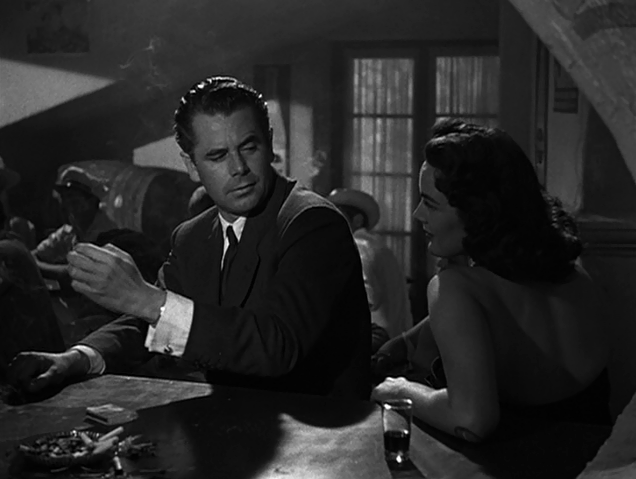
James Stewart gets top billing for Call Northside 777, even though his two previous films, Magic Town and It’s a Wonderful Life, were financial flops. Stewart wanted to play the role of investigative reporter P. J. McNeal (aka Mac, aka James) in Call Northside 777 precisely because it was different compared to his previous roles and because he hoped it would tweak his on-screen image and give it a boost. The role is different for Stewart, although the on-screen persona for which he is most famous does get to shine through toward the end, when he tries to convince members of the Illinois prison board to examine the new evidence that he has found in the Frank Wiecek case.

In spite of its poor showing at the box office, It’s a Wonderful Life was nominated for five Academy Awards, including Best Picture, and James Stewart was nominated for Best Actor. I am guessing that Stewart’s acting and reputation still had some cachet at the time. And, of course, It’s a Wonderful Life is a holiday standard today.
The film starts with a voice-over narrator explaining the city’s history in brief (very brief!), starting with the Great Chicago Fire in 1871, which allowed the city to rebuild itself. Scenes for the film are mixed with actual newsreel footage. The Prohibition years were the most violent, and the year 1932 was exceptionally violent. This leads right into the topic of the film: December 9, 1932, the date of the murder on which the film is based. In the film, two men enter Wanda Skutnik’s store, which is a front for a speakeasy. They shoot Patrol Officer John Bundy, who had entered the store just minutes earlier to get in from the cold.
The Chicago police get the name of Tomek Zaleska from a tip. When they learn that he had spent the night of December 9 with his friend Frank Wiecek, they bring in Wiecek and his wife Helen for questioning. Small insignificant points in Frank’s story differ from that of his wife, and so he is charged with murder, along with Zaleska, and both are convicted. Both maintain throughout that they are innocent.

Eleven years later, Brian Kelly, the city editor for the Chicago Times, sees an ad in the classified section that gives the film its title:
“$5000 reward for killers of Officer Bundy on December 9, 1932. Call Northside 777. Ask for Tillie Wiecek, 12–7 p.m.”
He decides that McNeal should investigate the ad. At the time, even eleven years after the trial, almost everyone in Chicago would have been familiar with the real-life story and would have remembered it.
McNeal finds out that Frank’s mother, Tillie Wiecek, placed the ad. She has worked and saved for eleven years washing floors to offer the reward money. Tillie believes in her son and knows that he is innocent. McNeal sees the human interest potential in the story and writes a newspaper article about Tillie Wiecek. Newspaper readers love the story, and many of them write and call in to the newspaper about it.

(This article about Call Northside 777 contains spoilers.)
City editor Kelly wants McNeal to write a follow-up story, and McNeal decides to go to the Illinois State Penitentiary at Stateville to interview Frank Wiecek. Wiecek maintains his innocence, as he has always done. He tells McNeal the following: (1) The judge in the case, Judge Moulton, thought that Wiecek and Tomek Zaleska were innocent; (2) Wiecek’s court-appointed lawyer was a drunk; and (3) Wanda Skutnik, the eyewitness at the trial who claimed that she saw Wiecek and Zaleska shoot the patrol officer, couldn’t identify Frank Wiecek and Tomek Zaleska at first, but then she did identify both in court.
McNeal’s second article about Frank Wiecek is another success, and his boss Brian Kelly wants him to continue writing articles on the Wiecek case. McNeal isn’t very happy about continuing the series because he doesn’t believe in Wiecek’s innocence at first. He’d rather focus on what he thinks are more pressing matters in the city. So he decides to interview the ex-wife to see why she divorced Frank Wiecek. Maybe she has some information that will give a negative slant to the Wiecek case, McNeal can end the series once and for all.
Helen Wiecek has since remarried and goes by the name Helen Rayska. When McNeal visits her at her home, he learns that it was Frank’s idea for Helen to divorce him so that their son would no longer have what some saw as a cop killer’s last name. Frank didn’t want his son to be bullied by other students at school.
McNeal’s feelings about the Wiecek case begin to change at this point. He writes another article, this time about Helen Rayska. His articles still revolve around the human interest aspects of the case, but he starts to see the value of continuing to investigate because so many people close to Frank believe in him so strongly.

The next time that McNeal meets Frank Wiecek at the state prison, it’s at the invitation of Frank himself. Frank tells McNeal that he doesn’t want him writing any more articles about his ex-wife and his son. He is adamant about protecting both; that was his whole purpose in obtaining a divorce. Newspaper publicity is just bringing more attention them and revealing their true identities. McNeal decides to talk to Tomek Zaleska, who also continues to maintain his innocence. This meeting pushes McNeal to continue probing, and his investigation comes down to the eyewitness Wanda Skutnik, who now goes by the last name Siskovich.
McNeal discovers that Skutnik was coached by a police captain about her testimony in court. It’s possible, too, that she was paid to identify Frank Wiecek and Tomek Zaleska as the killers. He becomes more and more dedicated to finding out the truth, even putting his own life in danger when he confronts police officers and residents in the Polish neighborhood of Chicago. He is blocked at almost every turn, and he never does discover who killed the patrol officer, but he does learn that both Wiecek and Zaleska were wrongly convicted.
Call Northside 777 is based on a real case about two wrongly convicted men in the killing of a police officer in 1930s Chicago. Click here for more information at Wikipedia about the arrest and conviction of Joseph Majczek and Theodore Marcinkiewicz, whose case formed the basis for Call Northside 777 (1948) and inspired the film Railroaded! (1947). Click here for even more details about the case from the School of Law at Northwestern University. Click here to see my article about Railroaded!
I always feel that the audio commentary is worth a listen, and the commentary provided by James Ursini and Alain Sliver is no exception. According to Ursini and Silver, the film mostly sticks to the facts of the original case, with a few exceptions. One is the use of the newspaper photograph as evidence at the end of the film. Here are a few additional points they make about Call Northside 777:
◊ The scenes in the prison were shot in the actual prison. The case on which the film is based led to many reforms in Illinois. The case was rather famous at the time, and many audience members would have known something about it.

◊ The real-life inventor of the polygraph, Leonard Keeler, plays himself. Keeler invented the polygraph when he was twenty-two, but he was forty-four when the film was shot. The polygraph scene is long by modern standards. It was a new technology at the time, and audiences then would have been interested in the details of its use.
◊ The film used real locations, real Chicago police officers, and real inhabitants of Chicago’s Polish neighborhood. A lot of the actors in supporting roles were Chicago locals.
◊ James McGuire, the real-life reporter who was the basis for the McNeal character, was suspicious that two men convicted of killing a police officer didn’t get life but instead got a sentence of ninety-nine years each. [The article at Wikipedia mentions that McGuire was suspicious about the outcome of the trial because Joseph Majczek and Theodore Marcinkiewicz didn’t get death sentences. The death penalty was still in wide use in the 1940s.]
◊ Karin Walsh was the real-life editor, but the character in the film is a male because of stereotypes at the time. Lee J. Cobb plays the city editor, Brian Kelly. Cobb named names to the House Un-American Activities Committee (HUAC) and tarnished his reputation by doing so.
◊ Helen Walker plays McNeal’s wife, but she usually played femme fatales. The role of Mrs. McNeal was a change for her.

James Stewart is fantastic in the role of McNeal, and the same can be said about all the actors in their roles. Helen Walker may have been playing a role against type, but she is very good at giving McNeal a softer edge, even before he comes around to seeing the potential in the human interest side of Wiecek and Zaleska’s story and way before he begins to believe in the innocence of both men.
Kasia Orzazewski matches James Stewart’s level of acting in her performance of Frank’s mother, Tillie Wiecek (based on the real-life mother Tillie Majczek). She inspires McNeal to investigate her son’s false imprisonment, and she eventually becomes one of the reasons that he becomes emotionally invested in the Wiecek case. At one point in McNeal’s investigation, he believes that he has exhausted the last possibility, the last hope for Frank’s release. The scene where he visits Tillie to break this news is very simple. It’s just the two of them in her small, bare living quarters, and it is incredibly moving.

But there is little doubt that Stewart carries the film. Most of the narrative is the story of McNeal’s investigation, which eventually becomes a search for justice. It is a powerful story, and its basis in fact just adds to that power.
The scenes shot on location and the voice-over narrator’s introduction give the film a semidocumentary feel, which is especially evident in the prison scenes and in McNeal’s investigations in the Polish neighborhood. In addition to being a great story, Call Northside 777 gives viewers a glimpse of history, a glimpse into Chicago’s past. If you are interested in history like I am, the history behind the story is an added plus to seeing the film.
February 1, 1948, release date • Directed by Henry Hathaway • Screenplay by Jerome Cady, Jay Dratler • Based on a 1944 Chicago Daily Times articles by James P. McGuire, Jack McPhaul • Music by Alfred Newman • Edited by J. Watson Webb Jr. • Cinematography by Joseph MacDonald
James Stewart as James (P. J.) McNeal • Richard Conte as Frank Wiecek • Lee J. Cobb as Brian Kelly • Helen Walker as Laura McNeal • Betty Garde as Wanda Skutnik • Kasia Orzazewski as Tillie Wiecek • Joanne De Bergh as Helen Wiecek • Michael Chapin as Frank Wiecek Jr. • Howard Smith as K. L. Palmer • Moroni Olsen as chair of the pardon board • J. M. Kerrigan as Sullivan • John McIntire as Sam Faxon • Paul Harvey as Martin J. Burns • George Tyne as Tomek Zaleska • Michael Chapin as Frank Wiecek Jr. • Leonarde Keeler as himself • E. G. Marshall as Rayska • Thelma Ritter as the receptionist • Lionel Stander as Corrigan, Wiecek’s cellmate • Truman Bradley as the narrator • Samuel S. Hinds as Judge Charles Moulton
Distributed by Twentieth Century Fox Film Corporation • Produced by Twentieth Century Fox Film Corporation